
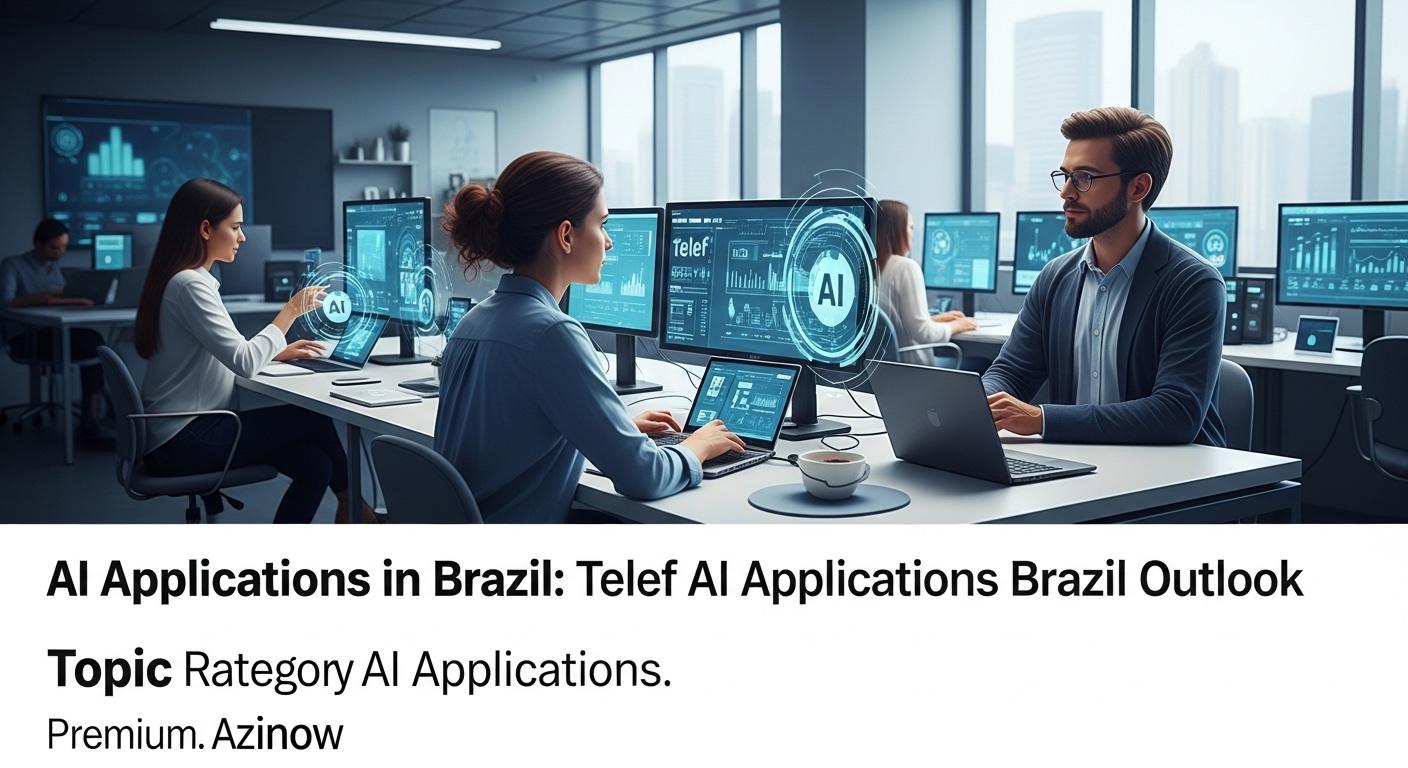
Brazilian AI deployment across telecom and financial sectors.
Updated: March 16, 2026
In Brazil, telef AI Applications Brazil is reshaping how enterprises integrate artificial intelligence with cloud, data, and automation across sectors, urging executives to rethink vendor ecosystems and local capabilities.
Context: Brazil’s AI infrastructure and policy
Brazil’s AI momentum emerges from a layered ecosystem that blends public policy, private investment, and a rapidly evolving cloud market. The country’s data governance framework, anchored by the General Data Protection Law (LGPD) and overseen by the national data authority, creates a baseline for responsible AI development while inviting scrutiny of data localization and cross-border transfers. At the same time, Brazil has been expanding digital infrastructure—5G rollout, fiber deployment, and data center capacity—that enables real-time analytics, edge computing, and scalable AI services. In this landscape, firms increasingly demand interoperable AI platforms that run across public and private clouds, reducing friction between development, operations, and security. Telefônica Brasil, among others, has signaled a shift toward cloud-first IT architectures that emphasize open standards, modular microservices, and a more adaptable vendor ecosystem. These moves aim to balance speed to value with resilience, yet they also magnify questions about local capabilities, talent pipelines, and the region’s capacity to manage AI at scale without excessive dependence on foreign platforms.
Industry adoption: telcos, banks, and public sector
Across sectors, AI is moving from pilot programs to mission-critical operations. In telecommunications, AI-driven network automation, predictive maintenance, and customer-experience analytics are becoming standard tools to optimize capital expenditure and downlink performance in dense urban centers. Telefônica Brasil’s modernization efforts, which emphasize open-source components and cloud-native architectures, illustrate a broader trend: operators seeking agility to deploy new services while containing costs and risk. Financial institutions follow suit, using AI for fraud detection, credit scoring, and personalized product recommendations, often requiring robust data governance and real-time decisioning. Public-sector entities are also exploring AI to streamline social programs, monitor infrastructure, and improve disaster-response coordination, albeit within stricter procurement and transparency guidelines. The momentum is reinforced by cross-border collaborations and vendor ecosystems, including strategic alliances that pair local telecommunications expertise with global AI platforms. Reports of Nokia’s AI partnerships with TIM Brasil and Deutsche Telekom highlight a regional push to accelerate AI-enabled services through joint innovation with telecoms and technology providers. Taken together, these trends point to a Brazilian market that is leaning into AI as a core competency rather than a peripheral capability, with implications for technology choice, skills development, and competition dynamics.
Risks and governance: data privacy, skills, and localization
As AI deployments scale, Brazil confronts a set of governance and risk challenges. Data privacy and consent remain central concerns, requiring transparent model explanations and auditable decisioning, particularly in finance and public services. Localization of data and talent is a recurring theme: firms seek to balance regulatory compliance with the need for AI talent and cloud sovereignty, while also avoiding vendor lock-in that could hamper cross-sector interoperability. Skill gaps—data scientists, machine-learning engineers, and site reliability professionals—translate into longer implementation cycles and higher operational risk. Governance frameworks must address bias in models, continuous monitoring in regulated environments, and clear accountability for automated decisions. Enterprises that attempt to accelerate AI without building internal capability risk dependency on external providers, which may not align with Brazil’s varied regional contexts or with local cybersecurity standards. In this environment, open standards and modular architectures can help, but only if accompanied by robust governance, talent development, and transparent supplier relationships. The patchwork of incentives and constraints—ranging from tax breaks for cloud adoption to compliance costs—will shape how quickly and how responsibly AI scales in the Brazilian economy.
Pathways and scenarios for the next 3–5 years
Looking ahead, three plausible trajectories emerge. In the optimistic scenario, Brazil achieves rapid AI diffusion through a combination of favorable policy, private investment, and interoperable platforms. Public-private partnerships unlock data collaboration frameworks, enabling large-scale experimentation in health, public security, and urban planning. Banks and telcos institutionalize AI as a core capability, standardizing data pipelines, risk controls, and customer journeys, while regional data centers reduce latency and improve resilience. The baseline scenario features steady, project-based expansion where AI capabilities scale within individual verticals but cross-sector integration remains fragmented. Companies invest in cross-functional teams and shared data models, yet governance and interoperability bottlenecks slow full-scale adoption. In a cautious scenario, concerns about privacy, data localization requirements, and talent shortages constrain investment, leading to smaller pilots with limited deployment. To navigate toward the positive path, Brazilian enterprises must align AI programs with clear governance, invest in local talent, and build vendor-neutral architectures that emphasize open standards, portability, and security. These choices are not purely technical; they are strategic bets about how Brazil will balance growth with control in a data-driven economy.
Actionable Takeaways
- Develop an open, modular AI platform strategy that supports multi-cloud deployment and avoids vendor lock-in.
- Strengthen data governance with clear ownership, documentation, and audit trails for every AI use case.
- Invest in local talent pipelines—data engineers, ML engineers, and AI ethics specialists—to reduce reliance on external expertise.
- Create pilot programs with measurable governance metrics, expanding only after scalable, compliant results are demonstrated.
- Engage early with regulators to align AI initiatives with LGPD requirements and to influence future policy design responsibly.