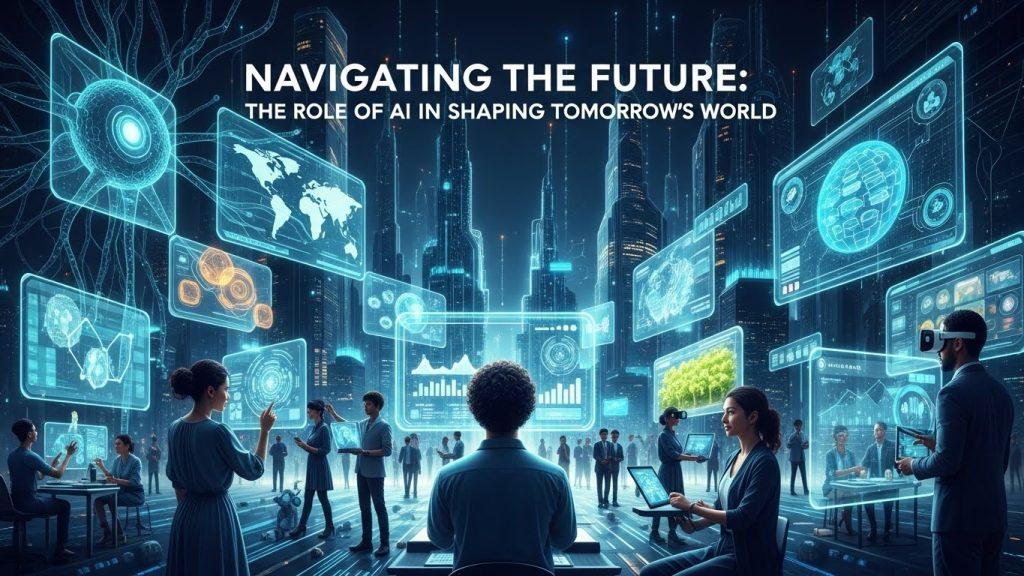
Navigating the Future: The Role of AI in Shaping Tomorrow’s World
The rapid advancement of Artificial Intelligence (AI) is revolutionizing various industries and reshaping the landscape of the global economy. As AI continues to evolve, its implications for the future become increasingly profound. This article delves into the multifaceted role AI will play in shaping tomorrow’s world, exploring its potential benefits and the challenges it poses.
AI in Healthcare: Revolutionizing Patient Care
AI is transforming the healthcare industry by enhancing diagnostic accuracy, personalizing treatment plans, and improving patient outcomes. Machine learning algorithms can analyze vast datasets to identify patterns and predict disease outbreaks, enabling early intervention and prevention.
One notable application of AI in healthcare is in oncology, where AI-powered tools assist in detecting cancerous cells more accurately than traditional methods. By analyzing medical images, AI algorithms can identify minute anomalies that may be missed by the human eye. This not only speeds up diagnosis but also increases the chances of successful treatment.
Moreover, AI-driven chatbots and virtual health assistants are improving patient engagement and access to information. These tools provide immediate responses to health queries, schedule appointments, and offer medication reminders, enhancing the overall patient experience.
The Impact of AI on Education: Personalized Learning Experiences
Education is another sector experiencing a significant transformation due to AI. Personalized learning experiences enabled by AI technologies are paving the way for more effective teaching methods. Intelligent tutoring systems analyze individual student data to tailor learning materials and strategies, catering to each student’s unique needs.

AI also facilitates the creation of immersive learning environments through virtual and augmented reality. These technologies allow students to explore complex subjects interactively, enhancing comprehension and retention.
Additionally, AI-powered administrative tools streamline educational management by automating tasks such as grading and scheduling, freeing up educators to focus more on teaching and less on bureaucratic duties. As a result, educational institutions can operate more efficiently and effectively.
AI and the Future of Work: Automation and Job Transformation
The integration of AI into the workforce is a double-edged sword. While it promises to increase productivity and efficiency, it also raises concerns about job displacement. Automation is transforming industries by taking over repetitive and mundane tasks, allowing humans to focus on more creative and strategic activities.
Nevertheless, the shift towards an AI-driven economy necessitates a reevaluation of the skills required for future jobs. Workers will need to adapt by acquiring new skills and embracing lifelong learning to remain competitive in the job market. For instance, roles in AI management, data analysis, and cybersecurity are expected to grow in importance.
Governments and organizations must proactively address the potential challenges posed by AI in the workplace. Policies that promote re-skilling and up-skilling are essential to ensure a smooth transition to an AI-enhanced economy.
AI and Ethical Considerations: Navigating the Challenges
As AI becomes more prevalent, ethical considerations take center stage. Concerns about privacy, bias, and accountability are significant hurdles that need to be addressed to ensure AI technologies are developed and deployed responsibly.
AI systems are only as good as the data they are trained on. Therefore, ensuring the quality and diversity of training data is crucial to prevent biased outcomes. Moreover, transparency in AI decision-making processes is vital to building trust and accountability.
Organizations like the World Economic Forum are actively working towards establishing ethical guidelines for AI development, aiming to create a framework that balances innovation with responsible practice.
AI in Environmental Conservation: A Sustainable Future
AI is playing a pivotal role in environmental conservation, offering innovative solutions to some of the planet’s most pressing challenges. By analyzing environmental data, AI can help monitor biodiversity, predict natural disasters, and optimize resource management.
For example, AI-powered drones and satellite imagery are being used to track deforestation and illegal wildlife activities, enabling prompt action to protect endangered species and habitats. Additionally, AI algorithms are optimizing energy consumption in smart grids, contributing to more sustainable and efficient energy use.
Collaboration between AI researchers and environmental organizations is crucial in leveraging technology to combat climate change and promote sustainability. By harnessing the power of AI, we can develop strategies that balance human progress with environmental preservation.
AI and Security: Bolstering Defense Mechanisms
The integration of AI in security systems is enhancing the ability to detect and respond to threats more efficiently. AI technologies are being used to improve cybersecurity measures by identifying anomalies and potential breaches in real-time.
AI-driven surveillance systems can analyze video footage to detect suspicious activities, aiding in crime prevention and ensuring public safety. Moreover, AI is being utilized in the development of autonomous defense systems, which can rapidly respond to threats in critical situations.
However, the use of AI in security also raises concerns about privacy and the potential for misuse. It is essential to establish regulatory frameworks that govern the use of AI in security to protect individual rights while enhancing safety.
Conclusion: Embracing the AI-Driven Future
As we navigate the future, the role of AI in shaping tomorrow’s world cannot be overstated. From revolutionizing healthcare and education to transforming the workforce and addressing environmental challenges, AI offers unprecedented opportunities for progress and innovation.
However, the path forward requires careful consideration of ethical implications and proactive measures to address potential challenges. By fostering collaboration between governments, organizations, and individuals, we can harness the power of AI to create a future that is not only technologically advanced but also inclusive and sustainable.
Ultimately, embracing AI responsibly and ethically will be key to unlocking its full potential and ensuring a brighter future for generations to come.
The Role of AI in Transportation: Paving the Way for Autonomous Vehicles
AI is at the forefront of transforming the transportation industry, particularly through the development and implementation of autonomous vehicles. These self-driving cars promise to revolutionize how people commute, potentially reducing traffic congestion and minimizing the incidence of road accidents caused by human error.
The technology behind autonomous vehicles relies heavily on AI algorithms that process data from sensors, cameras, and GPS systems to navigate roads safely. Companies like Tesla are leading the charge in making autonomous driving a reality, continuously improving their systems to handle complex driving scenarios.
Moreover, AI-driven logistics solutions are optimizing supply chains by predicting demand and optimizing delivery routes, which reduces fuel consumption and enhances efficiency. The integration of AI in transportation is expected to improve the overall quality of life by making travel safer, faster, and more environmentally friendly.
AI in Finance: Enhancing Decision-Making and Risk Management
The financial sector is leveraging AI to enhance decision-making processes and improve risk management. AI algorithms analyze vast amounts of financial data in real-time, providing insights that help in making informed investment decisions and detecting fraudulent activities.
For instance, AI-powered robo-advisors offer personalized investment advice based on individual financial goals and market trends. These tools democratize access to financial planning services, making them more accessible to a broader audience.
Additionally, AI is being used to enhance credit scoring systems, providing a more accurate assessment of an individual’s creditworthiness. This not only benefits financial institutions by reducing default risks but also enables consumers to access credit more easily.
As AI continues to evolve, its role in the financial sector will likely expand, further transforming how financial institutions operate and interact with their customers.
AI in Entertainment: Redefining Content Creation and Consumption
The entertainment industry is undergoing a significant transformation with the advent of AI technologies. From content creation to personalized recommendations, AI is redefining how media is produced and consumed.
AI algorithms are being used to generate content, including music, art, and even scripts for films and television shows. This technology enables creators to explore new frontiers of creativity, producing innovative and captivating experiences for audiences.
Moreover, streaming platforms like Netflix and Spotify utilize AI-driven recommendation systems to personalize user experiences. By analyzing user preferences and viewing habits, these platforms suggest content that aligns with individual tastes, enhancing user engagement and satisfaction.
The integration of AI in entertainment is not only enhancing content delivery but also opening up new avenues for creative exploration and audience interaction.
AI in Agriculture: Transforming Crop Management and Food Production
AI is playing a crucial role in modernizing agriculture and addressing global food security challenges. Through precision agriculture, AI technologies are optimizing crop management and increasing yields.
AI-powered drones and sensors monitor crop health, soil conditions, and weather patterns, providing farmers with actionable insights to make informed decisions. This data-driven approach allows for precise irrigation, fertilization, and pest control, minimizing waste and enhancing productivity.
Furthermore, AI is being used to develop automated harvesting systems, reducing labor costs and increasing efficiency. By streamlining agricultural processes, AI contributes to sustainable food production and helps meet the growing demand for food globally.
The continued adoption of AI in agriculture holds the promise of revolutionizing food systems and ensuring a sustainable and secure future for the global population.
Conclusion: The Promise and Responsibility of AI
As we look to the future, AI stands as a transformative force with the potential to address some of the most pressing challenges facing humanity. Its applications across various industries demonstrate its versatility and capacity to drive innovation and progress.
However, with great power comes great responsibility. The ethical implications and potential risks associated with AI must be carefully managed to ensure that it serves the greater good. By fostering a collaborative approach that includes stakeholders from diverse fields, we can guide the development of AI in a direction that is ethical, inclusive, and beneficial for all.
Ultimately, embracing AI with a focus on ethical considerations and societal well-being will be key to unlocking its full potential and ensuring that it contributes positively to the future of our world.
About the Author