
Battlefield 6 updates: what we know and what is unconfirmed
Updated: March 16, 2026
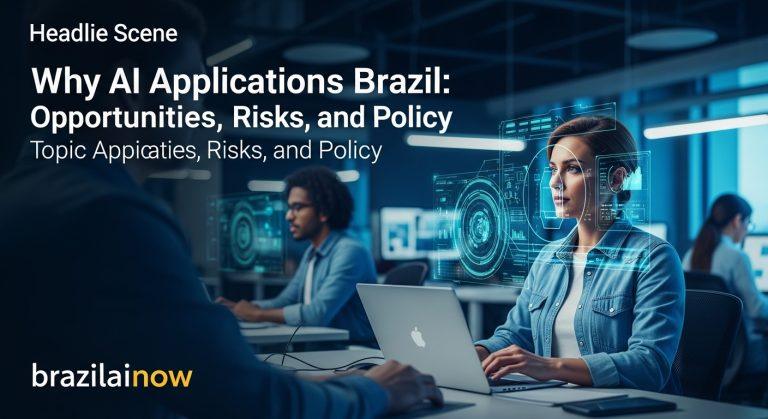
Across Brazil, sbc AI Applications Brazil stands at the nexus of enterprise ambition and public policy as companies race to deploy generative tools, automate operations, and tailor services to a digitally literate public. The phrase sbc AI Applications Brazil is more than a trend; it signals a framework for how AI will be integrated across sectors from fintech to agriculture, and how regulators will balance innovation with consumer protection. This analysis examines the forces at play, the lines of causality that could determine success or setback, and the scenarios that Brazilian leaders should consider as they chart a practical path forward.
The Brazil AI landscape and sbc AI Applications Brazil
Brazil has reached a tipping point where AI is less a pilot project and more a core operating assumption for competitive advantage. In industries such as agribusiness, fintech, and retail, companies are layering AI-enabled decision support, predictive maintenance, and intelligent customer interfaces onto existing processes. The Brazilian market increasingly demands tools that respect local privacy norms, data sovereignty, and language nuance, while still delivering faster insights and personalized experiences. Within this ecosystem, sbc AI Applications Brazil serves as a reference point for how multinational approaches can be localized to fit Brazilian consumer behavior, regulatory contexts, and infrastructure realities.
A notable development is the growing alignment between event organizers and technology providers. For example, SBC Summit Rio has begun naming official AI partners to illustrate how the region’s sports-betting and entertainment sectors are deploying AI as a strategic differentiator. Such partnerships signal not only product capability but a broader trend: AI is becoming a built-in consideration for event ecosystems that seek to optimize everything from sponsorship targeting to attendee data governance.
Beyond entertainment and gaming, AI tooling is seeping into risk management in betting platforms and financial services, where automated moderation, fraud detection, and customer verification rely on scalable, explainable algorithms. The Brazilian market is watching how these deployments balance speed, transparency, and user trust—a dynamic that will influence how quickly AI-based services scale from pilot programs to everyday usage.
Regulation, risk, and consumer protection in AI deployment
Brazil’s data protection regime and digital governance landscape impose clear expectations for AI deployment. The General Data Protection Law (LGPD) governs how personal data is collected, stored, and processed, and it imposes responsibilities on organizations to minimize risk and ensure transparency. As AI systems increasingly operate in customer-facing domains, companies must consider explainability, bias mitigation, and auditability as routine operating requirements rather than afterthoughts. This has practical implications: procurement teams must demand robust vendor governance, and compliance teams must build monitoring dashboards that can demonstrate ongoing adherence to privacy and fairness standards.
One emergent concern highlighted by observers is the potential misuse of self-exclusion and responsible-gaming mechanisms. While such platforms can dramatically improve consumer protection by helping at-risk players, there is also risk of misapplication or gaming the system if data are not handled with care or if automated decisions lack appropriate human oversight. Policymakers and operators will likely push for more granular controls, better telemetry, and stronger explainability when AI informs eligibility decisions, caps, or sanctions. The outcome depends on a calibrated approach that reduces harm without stifling legitimate user experiences.
These regulation-driven dynamics create a causal chain: clearer governance and internal risk controls encourage consumer trust, which in turn expands the usable addressable market for AI-enabled services. Conversely, overbroad restrictions or opaque vendor practices can hamper innovation and push activity into less-regulated spaces. The Brazil-wide trajectory will hinge on whether regulators and industry players co-create practical standards that reflect both local culture and global best practices.
Investment, partnerships, and market momentum
Global capital and technology partners are increasingly paying attention to Brazil’s AI potential, and local players are responding with strategic collaborations. A notable example is the emergence of formal AI partnerships tied to major industry events, where organizers seek qualified technology partners to demonstrate real-world capabilities. Such arrangements matter because they signal a trajectory where AI is not an optional add-on but a core component of customer experience, risk management, and back-end efficiency. For Brazil, this means a faster maturation of AI ecosystems, with local talent channels, cloud infrastructure, and data governance practices co-evolving to meet commercial needs.
Beyond event partnerships, international players are courting Brazilian opportunities in cloud services, AI tooling, and regulatory-compliant data processing. The flow of capital and expertise is creating a feedback loop: as more AI solutions demonstrate measurable value in sectors like fintech, logistics, and manufacturing, more Brazilian firms will adopt these tools to stay competitive. If this momentum aligns with clear regulatory guardrails and strong consumer protections, the domestic market could see a virtuous cycle of investment, experimentation, and scalable deployment.
Actionable Takeaways
- Map AI opportunities to concrete business outcomes while prioritizing privacy-by-design and data governance from the outset.
- Adopt an AI risk framework that covers fairness, explainability, and ongoing auditing, with clear governance roles for executives and boards.
- Invest in local talent and partnerships to ensure AI systems reflect Brazilian languages, market nuances, and regulatory expectations.
- Engage early with regulators and standard-setters to shape practical guidelines that support innovation without compromising consumer protections.
- Develop scenario planning for scale, including best-case, moderate-growth, and disruption scenarios, to prepare for regulatory changes or market shifts.
Source Context
- SBC Summit Rio partner announcement (iGamingToday) — context on official AI partnership dynamics within SBC events and Rio’s region-specific applications.
- Brazil’s Betting Self-Exclusion Platform registrations — highlighting risk-management capabilities and governance questions in consumer protection tooling.
- Global AI investment flows and Brazil’s positioning (industry analysis) — noting how multinational AI capital interacts with local regulatory and market dynamics.