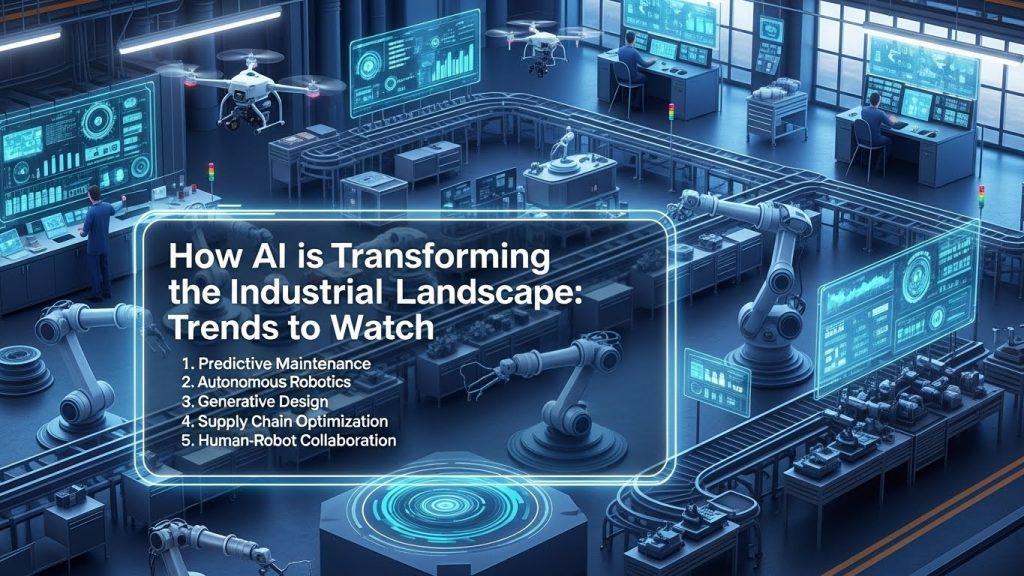
How AI is Transforming the Industrial Landscape: Trends to Watch
The industrial landscape is undergoing a massive transformation, driven by advancements in artificial intelligence (AI). As industries seek to enhance productivity, reduce costs, and improve safety, AI emerges as a crucial enabler of these objectives. This article explores how AI is reshaping the industrial sector, focusing on key trends and innovations that are setting the stage for the future.
The Rise of Smart Manufacturing
Smart manufacturing, also known as Industry 4.0, represents the integration of AI into manufacturing processes to create more efficient, flexible, and adaptive production lines. AI enables machines to perform tasks that were previously thought to require human intelligence, such as decision-making, problem-solving, and sensory perception.
One of the most significant impacts of AI in smart manufacturing is predictive maintenance. By using sensors and AI algorithms, manufacturers can predict when machines are likely to fail and perform maintenance proactively. This reduces downtime and extends the lifespan of equipment. According to McKinsey & Company, predictive maintenance can reduce maintenance costs by up to 20% and decrease equipment downtime by up to 50%.
AI and Robotics: A Perfect Union
The synergy between AI and robotics is transforming industrial operations by automating repetitive tasks, thus freeing human workers to focus on more complex and creative activities. AI-powered robots are increasingly used in assembly lines, quality control, and logistics operations.

For instance, in automotive manufacturing, AI-driven robots perform precise welding and painting tasks with minimal human intervention. These robots utilize machine learning algorithms to improve their efficiency and accuracy over time. Companies like BMW are leveraging AI and robotics to achieve unprecedented levels of production efficiency and product quality.
Enhancing Quality Control with AI
Quality control is a critical aspect of industrial processes, and AI is making significant strides in this domain. Traditional quality control methods often rely on manual inspection, which can be time-consuming and prone to human error. AI offers a solution through computer vision and machine learning technologies.
AI systems can analyze images or videos of products in real-time to identify defects and anomalies with high accuracy. This not only speeds up the inspection process but also ensures consistent quality standards. Companies in the electronics industry, for example, use AI for detecting defects in printed circuit boards, significantly reducing defect rates and improving customer satisfaction.
AI in Supply Chain Optimization
The supply chain is another area where AI is making a substantial impact. AI technologies are helping companies optimize their supply chains by enhancing demand forecasting, inventory management, and logistics planning.
AI algorithms analyze data from various sources, including market trends, historical sales data, and economic indicators, to forecast demand more accurately. This enables companies to maintain optimal inventory levels, reducing costs associated with overstocking or stockouts. Additionally, AI-powered logistics systems improve delivery times and reduce transportation costs by optimizing routing and scheduling.
Insights provided by Gartner indicate that AI in supply chain management can reduce forecasting errors by 20% to 50% and decrease lost sales by up to 65%.
AI and Human-Machine Collaboration
While AI is automating many industrial processes, it is also enhancing human-machine collaboration. Collaborative robots, or cobots, work alongside human workers to perform tasks that require a combination of human dexterity and machine precision.
Cobots are equipped with AI to understand and respond to human actions, making them ideal for tasks that require flexibility and adaptability. For example, in the pharmaceutical industry, cobots assist in packaging and labeling processes, where they handle repetitive tasks while humans focus on quality assurance and process optimization.
Challenges and Ethical Considerations
Despite the numerous benefits AI brings to the industrial landscape, it also presents challenges and ethical considerations. The adoption of AI in industries raises concerns about job displacement, data privacy, and algorithmic bias.
Companies must address these challenges by investing in workforce reskilling and upskilling programs to prepare employees for a future where AI and automation are prevalent. Additionally, ethical AI practices should be enforced to ensure that AI systems are transparent, fair, and free from bias.
Organizations such as The World Economic Forum emphasize the importance of responsible AI implementation and the need for public-private collaboration to create a sustainable and inclusive industrial future.
The Future of AI in Industry
The future of AI in the industrial sector is promising, with ongoing advancements poised to drive further innovation and efficiency. As AI technologies continue to evolve, industries can expect more sophisticated applications, such as autonomous production lines, self-healing machines, and intelligent supply chains.
Moreover, the integration of AI with emerging technologies like the Internet of Things (IoT), big data analytics, and 5G connectivity will unlock new possibilities for industrial transformation. These technologies will enable real-time data exchange and seamless communication between machines, leading to unprecedented levels of automation and optimization.
Takeaways
AI is undeniably transforming the industrial landscape, offering new opportunities for growth, efficiency, and innovation. From smart manufacturing and robotics to supply chain optimization and human-machine collaboration, AI is driving the next wave of industrial revolution.
As industries continue to embrace AI, it is crucial to address the associated challenges and ethical considerations to ensure a sustainable and inclusive future. By doing so, businesses can harness the full potential of AI to achieve competitive advantage and create a resilient industrial ecosystem.
AI-Driven Sustainability in Industry
Sustainability is a growing priority for industries worldwide, and AI plays a pivotal role in helping companies meet their environmental goals. By optimizing energy consumption, reducing waste, and improving resource efficiency, AI contributes significantly to sustainable industrial practices.
AI algorithms can analyze energy usage patterns and identify opportunities for reducing consumption without compromising productivity. For example, AI systems can optimize heating, ventilation, and air conditioning (HVAC) systems in factories to maintain optimal environmental conditions while minimizing energy use.
In the chemical industry, AI is being used to optimize chemical processes, thereby reducing waste and emissions. Advanced AI models simulate various process scenarios to find the most efficient and environmentally friendly production methods.
Moreover, AI is instrumental in advancing the circular economy by enabling more efficient recycling processes. AI-powered sorting systems can accurately identify and separate recyclable materials from waste streams, increasing recycling rates and reducing landfill contributions.
AI’s Role in Enhancing Worker Safety
Worker safety is a critical concern in industrial environments, and AI is making significant strides in this area. AI technologies are employed to monitor hazardous conditions, predict potential accidents, and provide real-time alerts to workers and management.
For example, AI-powered computer vision systems can detect unsafe behaviors, such as workers not wearing protective gear or entering restricted zones. These systems can automatically alert supervisors or intervene directly to prevent accidents.
Furthermore, AI is used in predictive analytics to assess risks and identify patterns that could lead to workplace incidents. By analyzing data from past accidents and near-misses, AI can help companies develop more effective safety protocols and training programs.
In mining, AI-driven autonomous vehicles and drones are used to explore hazardous areas, reducing the need for human workers to enter potentially dangerous environments. This application not only enhances safety but also increases operational efficiency.
AI in Industrial Training and Skill Development
The integration of AI in industrial training programs is revolutionizing how workers learn and develop new skills. AI-powered training platforms provide personalized learning experiences, adapting content to the individual needs and progress of each worker.
Virtual reality (VR) and augmented reality (AR) technologies are combined with AI to create immersive training simulations. These simulations allow workers to practice tasks in a controlled environment, reducing the risk of accidents during training and improving skill retention.
AI-driven analytics also play a role in assessing the effectiveness of training programs. By evaluating performance data, companies can identify areas where workers may need additional support or retraining, ensuring a skilled and competent workforce.
Conclusion: Embracing AI for a Competitive Edge
As AI continues to transform the industrial landscape, companies that embrace these technologies will gain a significant competitive edge. AI offers numerous benefits, from enhancing operational efficiency and product quality to improving sustainability and worker safety.
However, the successful integration of AI requires a strategic approach that addresses technical, ethical, and workforce challenges. Industries must invest in AI research and development, foster a culture of innovation, and prioritize ethical AI practices to fully realize the potential of these transformative technologies.
Ultimately, AI is not just a tool for automation; it is a catalyst for reimagining the future of industry. By leveraging AI’s capabilities, companies can navigate the complexities of the modern industrial landscape and drive sustainable growth and innovation.
About the Author