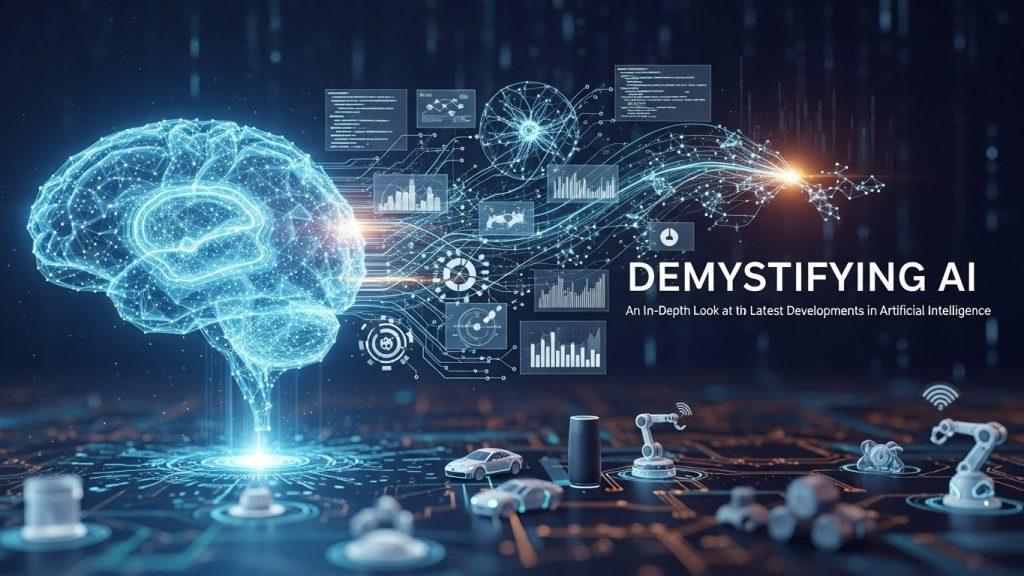
Demystifying AI: An In-Depth Look at the Latest Developments in Artificial Intelligence
Artificial Intelligence (AI) has rapidly transformed from a niche sector of computer science to a prominent force driving the technological revolution of the 21st century. From the devices we use daily to the advanced systems that power industries, AI’s impact is both profound and ubiquitous. This blog post aims to demystify AI, shedding light on its latest developments and exploring the implications of these advances on society and various sectors.
Understanding the Basics of AI
At its core, AI refers to the creation of systems that can perform tasks that typically require human intelligence. These tasks include learning, reasoning, problem-solving, perception, and language understanding. AI systems are designed to mimic human cognitive functions, allowing them to perform complex operations with speed and accuracy.
AI is broadly categorized into two types: Narrow AI and General AI. Narrow AI is designed to perform a specific task, such as facial recognition or language translation, and operates under a limited set of constraints. On the other hand, General AI is a theoretical construct that would have the ability to perform any intellectual task that a human can, with adaptability and learning capabilities.
Recent Advances in AI Technology
AI technology has seen tremendous growth in recent years, leading to groundbreaking developments across various fields. Below are some of the most notable advancements:
1. Natural Language Processing (NLP)

Natural Language Processing has made significant strides, enabling machines to understand, interpret, and respond to human language in a more natural way. Google’s BERT and OpenAI’s GPT models are prime examples of how NLP is being utilized to improve human-computer interaction. These models have been trained on vast amounts of text data, allowing them to generate coherent and contextually relevant responses.
2. Machine Learning and Neural Networks
Machine Learning, a subset of AI, focuses on building systems that can learn from and adapt to new data. Recent advances in neural networks, particularly deep learning, have led to significant improvements in image and speech recognition. For instance, convolutional neural networks (CNNs) are widely used in visual recognition tasks, powering technologies from autonomous vehicles to healthcare diagnostics.
3. Robotics and Automation
AI-driven robotics is revolutionizing industries by enhancing efficiency and precision. Robots equipped with AI capabilities are capable of performing complex tasks in manufacturing, logistics, and even healthcare. The integration of AI in robotics is leading to the development of collaborative robots, or cobots, which work alongside humans to increase productivity.
The Impact of AI on Various Industries
The influence of AI extends across numerous sectors, driving innovation and streamlining operations. Here are some key industries benefiting from AI advancements:
1. Healthcare
AI is transforming healthcare by improving diagnostic accuracy, personalizing treatment plans, and predicting patient outcomes. Technologies like IBM’s Watson have been instrumental in analyzing large datasets to provide actionable insights for medical professionals. Furthermore, AI-powered imaging tools are enhancing the early detection of diseases, leading to better patient care.
2. Finance
In the financial sector, AI is enhancing fraud detection, automating trading processes, and improving customer service through chatbots and virtual assistants. Algorithms are being used to analyze market trends and make investment decisions, providing a competitive edge to financial institutions.
3. Retail
Retailers are leveraging AI to enhance customer experiences, optimize supply chains, and personalize marketing strategies. AI-driven recommendation systems, like those used by Amazon, are tailoring product suggestions based on consumer behavior, thereby increasing sales and customer satisfaction.
Ethical Considerations and Challenges
Despite its potential, AI also presents several ethical challenges and concerns. Issues such as data privacy, algorithmic bias, and the displacement of jobs due to automation are significant hurdles that need to be addressed. Ensuring that AI systems are transparent, fair, and accountable is crucial for maintaining public trust and maximizing the benefits of AI technology.
Moreover, the lack of diversity in AI development teams can lead to biased algorithms that may perpetuate existing social inequalities. Initiatives to promote inclusivity and diversity in AI research are essential to creating fair and equitable AI systems.
The Future of AI: Opportunities and Speculations
The future of AI holds immense possibilities, from enhancing human capabilities to addressing global challenges. As AI continues to evolve, it is crucial to ensure that its development aligns with ethical standards and societal values. Collaborative efforts between governments, industries, and academia will be vital in steering the direction of AI advancements.
Speculations about the future of AI often revolve around the concept of Artificial General Intelligence (AGI), where machines could possess the ability to understand or learn any intellectual task that a human can. While AGI remains a long-term goal, the ongoing research in AI is laying the groundwork for achieving this milestone.
Takeaways
Artificial Intelligence is undoubtedly one of the most transformative technologies of our time. Its rapid development is reshaping industries, enhancing human capabilities, and presenting new opportunities and challenges. As we continue to explore the potential of AI, it is imperative to foster discussions on its ethical implications and ensure that its integration into society is both responsible and beneficial.
By understanding and addressing the complexities of AI, we can harness its power to improve our world while mitigating its risks. Stay informed about the latest breakthroughs in AI and join the conversation about its future to ensure that it remains a force for good.
AI in Education: Transforming Learning Experiences
Another sector significantly impacted by AI is education. AI technologies are being integrated into educational platforms to provide a more personalized learning experience. Intelligent tutoring systems can adapt to a student’s learning pace, offering customized content and feedback based on their progress. This ensures that learners receive the support they need, helping to close knowledge gaps and enhance understanding.
Moreover, AI is facilitating administrative tasks such as grading and scheduling, allowing educators to focus more on teaching rather than paperwork. Tools like automated essay scoring systems are being developed to assist teachers in evaluating student work efficiently. As AI continues to evolve, its role in promoting accessibility and inclusivity in education cannot be overstated.
AI and Environmental Sustainability
AI holds promise in tackling some of the most pressing environmental issues. By leveraging AI, researchers and organizations can analyze large datasets to identify patterns and predict environmental changes. For example, AI models can monitor deforestation, track wildlife populations, and predict natural disasters, providing crucial insights for conservation efforts.
Furthermore, AI is being used to optimize energy usage and reduce waste. Smart grids leverage AI algorithms to balance electricity supply and demand, minimizing energy consumption and promoting sustainability. Similarly, AI-driven systems in agriculture can optimize resource use, increasing crop yields while minimizing environmental impact.
AI Governance and Regulation
As AI continues to integrate into various aspects of life, the need for effective governance and regulation becomes paramount. Establishing robust frameworks that guide the ethical development and deployment of AI technologies is crucial. Governments and international bodies are working to develop policies that address issues such as data privacy, security, and the ethical use of AI.
Initiatives like the World Economic Forum’s AI and Machine Learning Platform aim to create guidelines and best practices for the responsible use of AI. These efforts are essential in ensuring that AI technologies are developed in a way that is transparent, accountable, and aligned with human values.
The Role of AI in Scientific Research
AI is revolutionizing scientific research by accelerating the discovery process and enabling researchers to tackle complex problems more efficiently. AI-driven tools are being used to analyze vast amounts of scientific data, identify patterns, and generate hypotheses. This allows scientists to make breakthroughs at an unprecedented pace.
In fields such as genomics, AI is being used to understand genetic information and develop personalized medicine. In chemistry, AI models are aiding in the discovery of new materials and drugs. The integration of AI into scientific research is paving the way for innovations that could significantly advance human knowledge and improve quality of life.
Challenges in AI Integration
While the potential benefits of AI are immense, there are also several challenges associated with its integration. One major issue is the digital divide, where unequal access to AI technologies could exacerbate existing social and economic inequalities. Ensuring equitable access to AI resources and education is crucial to preventing such disparities.
Additionally, the rapid pace of AI development poses challenges in terms of keeping regulations up to date. Policymakers must work closely with technologists to ensure that regulatory frameworks evolve alongside technological advances. This collaboration is essential to address potential risks and ensure the safe and ethical deployment of AI.
AI in the Creative Arts
AI’s influence extends even to the creative arts, where it is being used to generate music, art, and literature. AI algorithms can analyze artistic styles and create original works, offering new tools for artists and creators. While some may view this as a threat to human creativity, others see it as an opportunity for collaboration, where AI can inspire and augment human artistic expression.
For instance, AI-generated music can provide composers with new ideas and motifs to explore, while AI in visual arts can offer unique perspectives and techniques. The intersection of AI and creativity continues to be a fascinating area of exploration, pushing the boundaries of what is possible in the arts.
Conclusion: Embracing the AI-Driven Future
As we stand on the cusp of an AI-driven future, it is clear that the technology holds the potential to transform our world profoundly. From enhancing industries to addressing global challenges, AI offers opportunities to improve lives and drive progress. However, realizing this potential requires a careful and considered approach, balancing innovation with responsibility.
By fostering collaboration between technologists, policymakers, and society at large, we can ensure that AI develops in a way that is ethical, equitable, and aligned with human values. As AI continues to evolve, staying informed and engaged in discussions about its role and impact will be crucial in shaping a future where technology serves humanity for the greater good.
About the Author