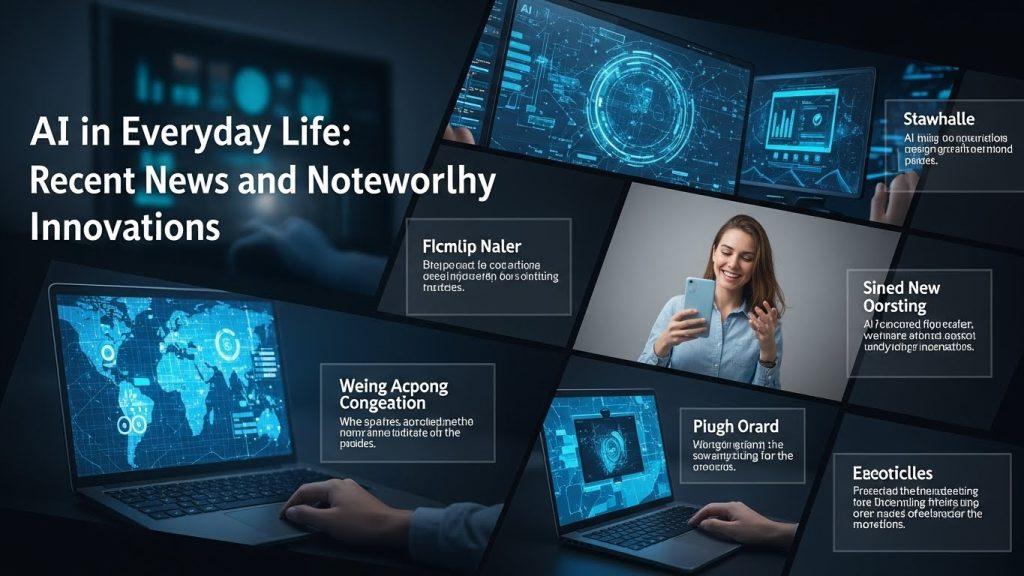
AI in Everyday Life: Recent News and Noteworthy Innovations
Artificial Intelligence (AI) has rapidly transitioned from a futuristic concept to an integral part of our daily lives. With advancements in technology and increasing accessibility, AI is reshaping the way we interact with the world. From virtual assistants to healthcare, AI is revolutionizing numerous industries, making tasks more efficient, and enabling new possibilities. In this post, we explore the recent news and noteworthy innovations in AI, highlighting how they enhance everyday life.
The Rise of AI in Consumer Technology
One of the most visible impacts of AI is in consumer technology. Devices that once seemed like science fiction are now commonplace in households around the world. Smart speakers, equipped with AI-powered assistants like Alexa, Siri, and Google Assistant, have changed how we manage our homes. These assistants can perform tasks from setting reminders to controlling smart home devices, all through voice commands.
According to a report by Statista, the number of digital voice assistants in use is projected to reach 8.4 billion units by 2024, surpassing the world’s population. This growth is driven by the increasing capabilities of AI, including improved language processing and understanding.
AI’s Influence in Healthcare
The healthcare industry is experiencing a revolutionary transformation thanks to AI. Machine learning algorithms are being used to predict patient outcomes, personalize treatment plans, and even detect diseases at early stages. For instance, AI systems can analyze medical images with remarkable accuracy, assisting radiologists in identifying anomalies more quickly and accurately.
Moreover, AI-driven wearable devices are empowering individuals to monitor their health in real-time. These devices can track vital signs, offer insights into physical activity, and alert users to potential health issues. The integration of AI into healthcare not only improves patient care but also reduces the burden on medical professionals.
AI in Autonomous Vehicles

Another significant area where AI is making strides is in the development of autonomous vehicles. Companies like Tesla, Waymo, and Uber are at the forefront of creating self-driving cars, which rely heavily on AI algorithms to navigate roads safely. These vehicles use sensors, cameras, and AI to interpret their surroundings, make decisions, and drive without human intervention.
The potential benefits of AI in autonomous driving include reduced traffic accidents, improved fuel efficiency, and enhanced mobility for individuals unable to drive. As these technologies evolve, they promise to reshape transportation infrastructure and urban planning.
AI in Education
AI is also transforming education by offering personalized learning experiences. Platforms like Khan Academy and Coursera use AI to tailor educational content to individual learning styles and paces. AI-driven analytics can identify areas where students struggle and suggest targeted resources to help them succeed.
Furthermore, AI-powered chatbots and virtual tutors provide students with on-demand assistance, enhancing their learning experience outside traditional classroom settings. These innovations are making education more accessible and effective for students worldwide.
AI in Environmental Sustainability
AI is playing a crucial role in addressing environmental challenges and promoting sustainability. Through data analysis and predictive modeling, AI helps monitor and manage natural resources more efficiently. For example, AI is used in precision agriculture to optimize crop yields while minimizing the use of water and fertilizers.
In addition, AI technologies are being employed to track wildlife populations, predict natural disasters, and reduce energy consumption in smart cities. These applications are crucial for developing sustainable practices that protect the environment for future generations.
Ethical Considerations and Challenges
Despite the numerous benefits, the integration of AI into everyday life raises ethical considerations and challenges. Issues related to privacy, data security, and algorithmic bias are at the forefront of discussions surrounding AI. Ensuring that AI technologies are used responsibly and ethically is essential to prevent misuse and protect individuals’ rights.
Organizations like the Google AI are actively working on developing ethical AI frameworks and guidelines to address these concerns. Collaboration between policymakers, technologists, and ethicists is crucial to navigate the complex landscape of AI ethics.
The Future of AI in Daily Life
As AI continues to evolve, its impact on everyday life will only increase. Emerging technologies such as quantum computing and advanced natural language processing will further enhance AI capabilities, opening up new possibilities across various fields. The continued integration of AI promises to make our lives more convenient, productive, and connected.
It is essential to stay informed about the latest AI developments and innovations. By understanding the potential of AI and its applications, individuals and businesses can better prepare for the future and leverage these technologies to their advantage.
Takeaways
AI is undeniably transforming the fabric of everyday life, introducing innovations that touch every aspect of society. From enhancing consumer technology and revolutionizing healthcare to advancing autonomous vehicles and promoting environmental sustainability, AI is a catalyst for change. While challenges and ethical considerations need to be addressed, the benefits of AI are immense, offering a glimpse into a future where intelligent systems make life more efficient, enjoyable, and sustainable.
AI’s Role in the Workplace
AI is reshaping workplaces across the globe, enhancing productivity and efficiency in numerous industries. Machine learning algorithms and automation tools are taking over repetitive tasks, allowing human workers to focus on more complex and creative endeavors. This shift is particularly evident in sectors like manufacturing, finance, and customer service.
For example, AI-driven chatbots are handling customer queries with increasing sophistication, providing instant support and freeing up human agents for more intricate issues. In finance, AI algorithms can quickly analyze vast datasets to detect fraud or optimize trading strategies, offering insights that were previously unattainable.
AI in Entertainment and Media
The entertainment and media industries are being transformed by AI, with content creation, distribution, and consumption becoming more personalized and engaging. Streaming platforms such as Netflix use AI to recommend content tailored to individual preferences, increasing viewer satisfaction and retention.
Furthermore, AI is now being used to create music, write scripts, and even generate realistic virtual environments for films and video games. These innovations are not only enhancing the quality of media content but also expanding the horizons of creativity and storytelling.
AI and Smart Cities
Smart cities are emerging as a significant application of AI, aiming to improve urban living through technology. AI is being used to optimize traffic flow, manage energy consumption, and enhance public safety. Sensors and cameras powered by AI can monitor city infrastructure in real-time, predicting maintenance needs and preventing failures.
Additionally, AI is helping to create sustainable urban environments by reducing pollution and managing waste more effectively. As cities continue to grow, the adoption of AI in urban planning and management will be crucial in addressing the challenges of urbanization.
AI in Retail and E-commerce
The retail sector is harnessing AI to redefine the shopping experience. From personalized recommendations to cashier-less stores, AI is enhancing convenience and efficiency for consumers. Retailers are using AI to analyze consumer behavior, optimize inventory management, and enhance supply chain operations.
E-commerce platforms, for instance, employ AI algorithms to predict trends and personalize marketing strategies, improving customer engagement and sales. AI-driven virtual assistants are also becoming commonplace, guiding customers through online shopping processes and providing tailored product suggestions.
Continuous Learning and AI Development
The rapid pace of AI development underscores the importance of continuous learning and adaptation. Professionals across industries are recognizing the need to upskill and embrace AI technologies to remain competitive. Online courses and certifications in AI and machine learning are becoming increasingly popular, offering individuals the opportunity to explore this dynamic field.
Organizations are also investing in AI research and development, fostering innovation and driving technological advancements. By staying ahead of the curve, businesses can leverage AI to gain a competitive edge and unlock new growth opportunities.
Final Thoughts
The integration of AI into everyday life is a testament to the transformative power of technology. As AI continues to evolve, its impact will become even more pronounced, offering solutions to some of the most pressing challenges faced by society. While the journey towards widespread AI adoption presents challenges, the potential benefits are immense, promising a future where intelligent systems enhance human capabilities and improve quality of life.
Staying informed about AI trends and innovations is essential for individuals and organizations alike. By understanding and embracing AI, we can maximize its benefits and navigate the complexities of this rapidly changing landscape, ultimately shaping a future where technology and humanity work in harmony.
AI in Agriculture
Agriculture is another sector experiencing significant transformation due to AI. Farmers are employing AI technologies to enhance crop production and sustainability. AI-powered drones and sensors are used to monitor crop health, assess soil conditions, and optimize irrigation systems.
Precision agriculture, facilitated by AI, enables farmers to make data-driven decisions that lead to higher yields and reduced environmental impact. By analyzing weather patterns, plant health, and pest activity, AI systems can recommend optimal planting and harvesting schedules, fostering more efficient agricultural practices.
AI in Logistics and Supply Chain Management
Logistics and supply chain management are also benefiting from AI innovations. AI algorithms are optimizing routes, improving delivery times, and reducing transportation costs. Real-time data analytics allow logistics companies to predict demand fluctuations, manage inventory effectively, and enhance customer satisfaction.
AI is also improving warehouse operations through automation and robotics, streamlining sorting and packaging processes. These advancements are crucial in an era where e-commerce is booming, and efficient supply chain management is a competitive differentiator.
AI and Cybersecurity
As cyber threats become increasingly sophisticated, AI is playing a vital role in enhancing cybersecurity measures. AI systems can detect and respond to threats in real-time, identifying anomalies in network traffic and preventing potential breaches.
Machine learning algorithms are being harnessed to predict and mitigate cyber threats before they occur, offering a proactive approach to cybersecurity. By continuously learning from new data, AI systems can adapt to evolving threats, providing robust protection for sensitive information.
AI in Finance and Banking
The finance and banking sectors are leveraging AI to improve customer service, risk management, and decision-making processes. AI-driven chatbots provide instant support for customer inquiries, while robo-advisors offer personalized investment advice based on individual risk profiles.
In lending, AI is being used to assess creditworthiness by analyzing non-traditional data sources, enabling more inclusive financial services. Fraud detection systems powered by AI can analyze transaction patterns to identify suspicious activities, enhancing security for both institutions and customers.
AI and the Future Workforce
The rise of AI is prompting discussions about the future of work and the skills required to thrive in an AI-driven world. While AI is expected to automate certain jobs, it is also creating new opportunities in fields such as data science, AI development, and human-AI collaboration.
Education systems are beginning to adapt by incorporating AI literacy into curricula, preparing students for a future where AI will be ubiquitous. Lifelong learning and skill development will be essential for workers to adapt to changing job requirements and capitalize on AI-enhanced opportunities.
Concluding Remarks
AI’s integration into everyday life is reshaping industries, enhancing capabilities, and offering solutions to complex challenges. As AI continues to advance, it is crucial to foster a collaborative environment where technology is developed and used responsibly.
By understanding and embracing the potential of AI, individuals and organizations can harness its power to drive innovation, improve quality of life, and create a more connected and efficient world. The journey toward widespread AI adoption is just beginning, and the possibilities are as vast as they are exciting.
About the Author